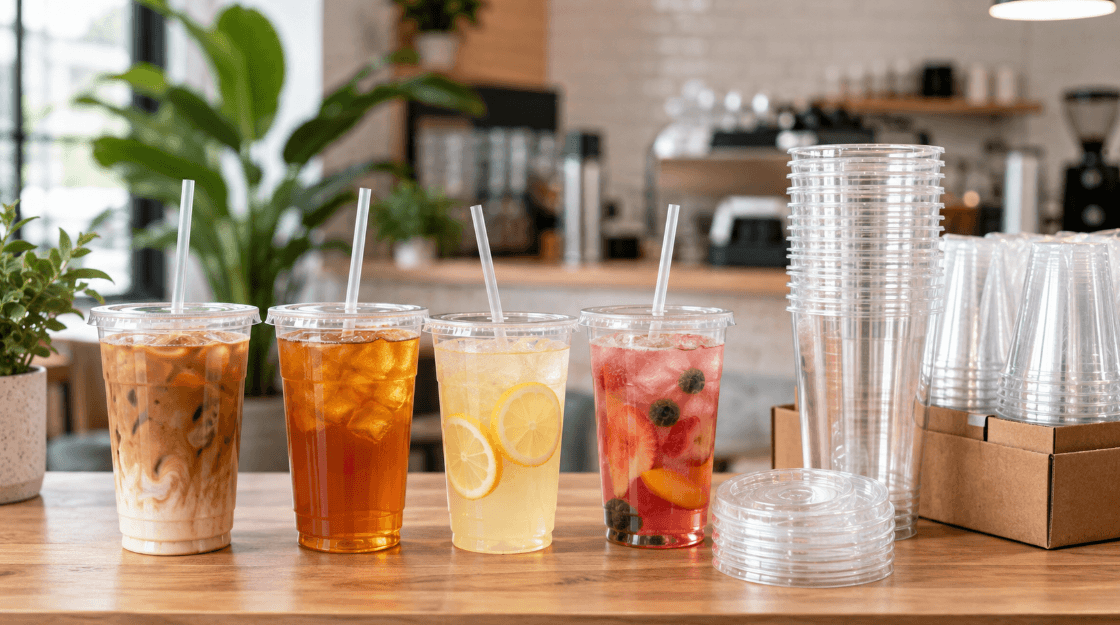
Disposable drink cups are a small part of foodservice operations, but they affect far more than beverage presentation. Cafés, juice bars, bubble tea shops, restaurants, hotels, event organizers, and takeaway businesses all depend on cups that need to perform reliably while meeting changing customer expectations.
For years, conventional plastic cups were the standard choice for cold beverages. They are transparent, lightweight, easy to stack, and suitable for displaying colorful drinks. Today, however, many foodservice operators are also investigating compostable alternatives as part of broader packaging and sustainability strategies.
This does not mean every conventional plastic cup can simply be replaced with a compostable version. Material properties, temperature limits, storage conditions, disposal infrastructure, certifications, lid compatibility, printing requirements, and purchasing volumes all need to be considered.
For businesses planning their next packaging order, understanding these factors can make the difference between choosing a cup that simply looks sustainable and selecting one that actually works in daily operations.
1. What Is a Compostable Plastic Cup?
The phrase “compostable plastic cup” generally refers to a cup made from a polymer designed to break down under specified composting conditions rather than remain as conventional petroleum-based plastic waste.
One of the most widely recognized materials used for transparent compostable cold cups is PLA, or polylactic acid.
PLA is a bio-based polymer typically produced from renewable plant-derived feedstocks. It can provide the clear appearance customers expect from conventional cold-drink cups while offering a different end-of-life pathway when appropriate composting systems are available.
This makes PLA particularly interesting for businesses serving products such as:
- iced coffee;
- smoothies;
- fruit juice;
- bubble tea;
- cold brew;
- iced tea;
- lemonade;
- desserts; and
- other chilled beverages.
However, compostable does not mean that a cup will instantly disappear in ordinary outdoor conditions. Commercial buyers should always understand the specific material, certification requirements, and disposal conditions associated with the product they purchase.
2. Why Foodservice Businesses Are Paying More Attention
Packaging has become part of the customer experience.
A customer no longer interacts only with the food or drink itself. They notice the cup, lid, straw, carrier, takeaway bag, graphics, material feel, and disposal instructions.
At the same time, restaurants and beverage brands face growing pressure from corporate sustainability policies, local packaging regulations, procurement requirements, and environmentally conscious customers.
As a result, purchasing teams are increasingly comparing conventional PET options with alternatives such as PLA.
Businesses researching compostable plastic cups wholesale should therefore look beyond the unit price alone. A proper comparison should include cup performance, available sizes, matching lids, printing capability, minimum order quantities, certification documentation, packing efficiency, and whether the material is appropriate for the intended beverage.
The cheapest cup is not necessarily the most economical choice if it creates problems during storage, filling, transportation, or service.
3. Transparency Still Matters
One reason clear plastic cups remain so popular is simple: customers can see the drink.
This is particularly important for modern beverage concepts.
Think about:
- layered iced coffee;
- colorful fruit tea;
- matcha drinks;
- smoothies;
- milk tea with toppings;
- fresh juice;
- parfaits; and
- cold desserts.
Visual presentation is part of the product.
Restaurants spend considerable time developing drink colors, garnishes, toppings, foam layers, fruit combinations, and other details. A transparent cup allows those elements to remain visible.
PLA cups can offer the familiar clear presentation associated with conventional cold-drink cups, making them easier to integrate into beverage businesses that do not want sustainability-related packaging changes to hide the product itself.
4. PLA and PET Are Not the Same Material
A common procurement mistake is assuming that clear cups are interchangeable because they look similar.
They are not.
PET is a widely used conventional plastic with excellent clarity, durability, and widespread foodservice applications.
PLA is a bio-based polymer used for certain compostable packaging applications.
The materials have different characteristics, especially when it comes to heat resistance and storage.
PLA is generally intended for cold applications. Excessive heat can cause deformation, which means operators should not choose a PLA cold cup for hot beverages simply because the dimensions are convenient.
Storage conditions can also matter.
A foodservice buyer should therefore provide the supplier with details such as:
- beverage temperature;
- filling method;
- storage environment;
- destination country;
- expected shelf life;
- transportation conditions; and
- intended use.
Good packaging procurement starts with the application rather than the material name.
5. Cup and Lid Compatibility Is Critical
A cup is only half of the packaging system.
The lid matters just as much.
Foodservice operators often work with several cup capacities while trying to reduce the number of different lid sizes kept in inventory. Standardizing rim diameters where possible can make purchasing and daily operations much easier.
For example, multiple cold-cup capacities may be designed around one common lid diameter.
This can help businesses:
- simplify inventory;
- reduce storage space;
- avoid staff mistakes;
- streamline purchasing;
- reduce leftover mismatched lids; and
- speed up service.
Before placing a large order, buyers should confirm the exact top diameter of every cup and verify which flat, dome, straw-slot, or specialty lids are compatible.
Never assume that two cups with similar capacities use the same lid.
See also: What Company Secretarial Services Hong Kong Businesses Need to Know
6. Think Carefully About Cup Sizes
Foodservice businesses often order too many sizes.
A café may start with one cup for iced coffee, another for juice, another for smoothies, another for promotional beverages, and another for seasonal drinks.
Over time, inventory becomes complicated.
A better strategy is to review actual beverage volumes and identify a limited size range that can cover most menu requirements.
Common cold-drink formats may include capacities around:
- 8 oz;
- 9 oz;
- 10 oz;
- 12 oz;
- 14 oz;
- 16 oz;
- 20 oz; and
- 24 oz.
The correct range depends on the business model.
A juice bar may prioritize larger sizes, while a specialty coffee shop may use a more compact range. Bubble tea businesses may require different heights or lid structures depending on toppings and sealing methods.
Selecting fewer standardized cup families can reduce purchasing complexity without limiting the menu.
7. Custom Printing Turns Packaging Into Advertising
A takeaway cup rarely stays inside the store.
Customers carry drinks through shopping centers, office buildings, universities, public transportation, parks, streets, and events.
This makes the cup a mobile piece of branding.
Custom printing can include:
- logos;
- brand colors;
- simple illustrations;
- slogans;
- social media handles;
- QR codes;
- campaign artwork; and
- disposal guidance.
Businesses do not necessarily need complicated graphics.
A clear cup with a simple one- or two-color logo can often look more professional than a heavily printed design.
Consistency matters more.
When the same visual identity appears on the storefront, menu, website, cup, delivery packaging, and social media content, customers are more likely to recognize the brand.
8. Wholesale Purchasing Requires Different Thinking
Buying cups for a single café location is very different from buying them for a restaurant chain, distributor, importer, hotel group, or foodservice wholesaler.
Wholesale buyers have to consider:
Minimum Order Quantity
Customized production normally requires larger volumes than buying generic stock from a local retailer.
The manufacturer needs to prepare material, production schedules, printing equipment, artwork, packaging, and quality-control procedures.
Carton Quantity
Buyers should know how many cups are packed per carton and how many cartons will be required for the full order.
Shipping Volume
Disposable cups are lightweight but occupy substantial space.
For international orders, cubic volume can therefore have a major influence on logistics costs.
Mixed Sizes
Importers purchasing container quantities may want several cup sizes in one shipment.
Before ordering, confirm whether the manufacturer allows mixed models and what minimum quantity applies to each size.
Lead Time
Custom printed products require artwork confirmation and production planning.
Ordering early is especially important before seasonal promotions, new-store launches, or major events.
9. Certifications Should Match the Claim
The word “compostable” should be supported by evidence appropriate to the target market.
Business buyers may need to review relevant testing or certification documents depending on where the products will be sold.
Requirements can vary between regions.
Importers, distributors, and larger foodservice groups should therefore ask suppliers for documentation before placing significant orders rather than relying entirely on marketing descriptions.
This is particularly important when packaging will carry environmental claims.
A procurement team should know exactly:
- what material the cup contains;
- which standard applies;
- what certification is available;
- whether certification covers the specific product;
- what disposal environment is required; and
- what claims may legally be printed on the packaging.
Accurate claims protect both the supplier and the customer.
10. Composting Infrastructure Still Matters
A compostable cup does not automatically create an environmental benefit simply because the material is technically compostable.
The local waste system matters.
If a city has access to appropriate collection and industrial composting facilities that accept the material, compostable packaging can form part of a more coherent waste strategy.
If no suitable system exists, the end-of-life outcome may be different.
Foodservice businesses should therefore investigate local infrastructure and communicate disposal instructions accurately.
This is especially important for chains operating in several cities or countries, because the same packaging may encounter different waste-management systems in different locations.
11. Avoid Overstating Environmental Claims
Consumers increasingly notice environmental language, but vague claims can create confusion.
Terms including:
“green”
“eco-friendly”
“biodegradable”
“compostable”
“plant-based”
and
“plastic-free”
should not automatically be treated as synonyms.
A PLA cup, for example, is generally described as a bio-based plastic rather than plastic-free packaging.
Businesses should use specific, verifiable terminology and avoid suggesting that a product will break down anywhere under any conditions.
Clear communication is more credible than exaggerated sustainability slogans.
12. Samples Are Important Before Large Orders
Before committing to a wholesale order, buyers should test samples using their actual beverages and service conditions.
Useful checks include:
- Fill the cup with the intended beverage.
- Test the cup at the actual serving temperature.
- Confirm lid fit.
- Check stacking behavior.
- Hold the filled cup as a customer would.
- Test it during normal takeaway periods.
- Evaluate clarity and appearance.
- Review printing position if customization is required.
- Confirm straw or lid opening compatibility.
- Check carton storage requirements.
A technical specification sheet can tell a buyer many things, but physical testing often reveals practical details that are difficult to judge on paper.
13. Choose Packaging as a Complete System
The strongest purchasing strategy is not simply asking:
“What is the price of this cup?”
A better question is:
“What packaging system will work best for our drinks, staff, customers, logistics, branding, and waste-management requirements?”
That may involve coordinating:
- cups;
- lids;
- straws;
- sleeves;
- carriers;
- takeaway bags;
- printed branding; and
- disposal communication.
Considering everything together can reduce unnecessary SKU complexity and make operations more efficient.
Conclusion
Compostable cups are becoming an increasingly visible option in modern foodservice, particularly for businesses that want transparent cold-drink packaging while exploring alternatives to conventional plastics.
But successful adoption requires more than changing materials.
Buyers need to evaluate beverage temperature, cup dimensions, lid compatibility, storage conditions, certification requirements, printing, order quantities, logistics, and local composting infrastructure.
For cafés and beverage brands, the right cup should support both daily operations and the customer experience. For importers and distributors, the decision also needs to make commercial sense at scale.
When material selection is based on real application requirements rather than marketing language alone, compostable cold cups can become a practical part of a broader foodservice packaging strategy.