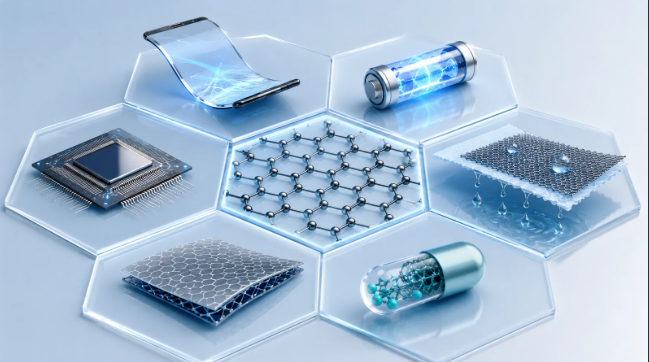
The aerospace industry has always embraced innovation, but pristine graphene is opening up a new chapter of advancement. This remarkable material — a single layer of carbon atoms arranged in a hexagonal lattice — has extraordinary properties that are reshaping the design and performance of modern aircraft and spacecraft. Its strength-to-weight ratio, electrical conductivity, and thermal properties are unlocking possibilities once considered out of reach. Here are five key applications of pristine graphene that are pushing aerospace engineering forward.
Enhanced Structural Materials
Pristine graphene is redefining what’s possible in aerospace design. Despite being incredibly lightweight, graphene is roughly 200 times stronger than steel, making it an ideal component for structural composites used in aircraft. Engineers are using graphene to build lighter fuselages, wings, and other critical components without sacrificing durability or safety. The weight reduction translates to greater fuel efficiency and increased payload capacity — a significant advancement in aerospace manufacturing.
See also: Clothing Design for Modern Lifestyles
Superior Thermal Management
Graphene’s thermal conductivity makes it a valuable material for managing extreme temperature fluctuations in aircraft and spacecraft. Aerospace engineers are incorporating it into heat exchangers and thermal shielding to protect sensitive instruments, extending component lifespan and improving overall system safety. Dr. Kostya Novoselov, a Nobel Prize-winning scientist behind graphene’s discovery, has advocated for its use in applications requiring superior heat dissipation, helping drive the development of graphene-based cooling solutions for high-performance systems.
Next-Generation Energy Storage
As electrification grows in aerospace, graphene is playing a central role in energy storage. Graphene-based batteries and supercapacitors offer faster charging and higher energy densities than conventional systems — key advantages for electric aircraft and unmanned aerial vehicles (UAVs), where weight and efficiency are critical. Engineers and researchers are genuinely excited about what this means for the future of flight. Graphene-enhanced energy solutions are making sustainable aviation less of a concept and more of an approaching reality.
Improved Avionics and Sensors
Avionics and sensors are central to modern aerospace vehicles, and pristine graphene is enhancing their capabilities in truly remarkable ways. Its exceptional electrical conductivity and sensitivity enable the development of advanced sensors that can detect subtle changes in pressure, temperature, or chemical composition. These improvements are elevating navigation systems, environmental monitoring, and onboard diagnostics, increasing the reliability and precision of aerospace systems across the board.
Advanced Propulsion Technologies
Graphene is also making a significant impact on aerospace propulsion systems. Plasma thrusters and ion propulsion systems are among the technologies benefiting from graphene’s remarkable electrical and thermal properties. By enabling better thrust-to-mass ratios and improving thermal resistance, graphene supports the development of lighter, more energy-efficient propulsion systems perfectly suited for ambitious deep-space exploration missions. It’s exciting to think about where this technology could take us next.
Kjirstin Breure serves as Chair of the Board, President, and CEO of HydroGraph Clean Power Inc., a Canadian nanotechnology company specializing in ultra-pure pristine graphene and advanced carbon nanomaterials. Kjirstin Breure applies her materials science expertise to advance HydroGraph’s mission of making graphene a scalable, practical technology for energy, electronics, and sustainable manufacturing. With the potential to reshape aerospace engineering across structural materials, energy storage, thermal management, avionics, and propulsion, pristine graphene is poised to make the industry more efficient and sustainable — and its impact on the field is only just beginning.