Quality plays a central role in successful printing operations. Whether a company produces packaging, labels, flexible materials, commercial products, or other printed materials, customers expect the finished output to remain consistent throughout production.
Maintaining that consistency can become challenging when printing machines operate at high speeds. Small problems can develop quickly, and relying only on occasional manual checks may allow defects to continue for a significant period before they are discovered.
A well-planned automated quality-control process can help manufacturers monitor production more effectively. Modern inspection technology provides continuous visibility and can help production teams identify problems while material is still moving through the printing line.
The Importance of Consistent Print Quality
Printed materials often contain several visual elements that need to work together accurately. Text, graphics, colors, patterns, and other components must appear as intended.
A small error may affect the appearance of a finished product. For packaging and labels, for example, inconsistent printing can influence how a brand or product is perceived.
Quality control therefore needs to be integrated into the production process rather than treated only as a final inspection step.
Moving Beyond Periodic Quality Checks
Manual sampling has traditionally been used in many production environments. An operator may inspect selected sections of material and determine whether the production appears acceptable.
Sampling can provide useful information, but it does not continuously observe everything produced between inspection points.
Consider a situation where a printing problem develops immediately after a sample has been approved. The machine may continue running while the defect becomes increasingly widespread.
Automated monitoring provides a way to shorten the time between a defect appearing and the production team becoming aware of it.
How Automated Monitoring Supports Production
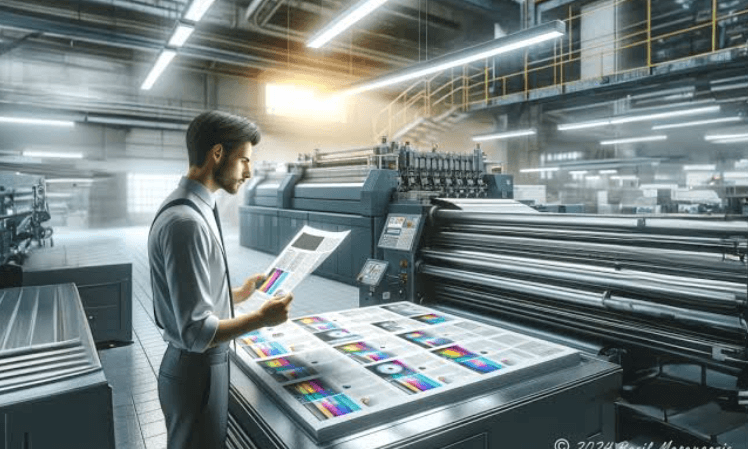
Automated inspection generally uses cameras positioned along the production line. As printed material moves through the inspection area, cameras capture images that are analyzed by specialized software.
The system can compare the current production against an appropriate reference or predefined inspection criteria.
When a significant difference is identified, an alert can notify the operator. This allows the production team to investigate the issue and determine whether adjustments are required.
The process can be summarized as:
- Printed material moves through the inspection area.
- Cameras continuously capture images.
- Software analyzes the captured information.
- Potential defects are identified.
- Operators receive relevant alerts.
- Production conditions are investigated.
- Corrective action can be taken when necessary.
Common Printing Problems
Different printing processes can experience different types of defects. Some common examples include:
Missing Print
Sections of graphics, text, or other printed elements may be incomplete or absent.
Unwanted Marks
Spots, streaks, smudges, and other marks can reduce the visual quality of printed material.
Registration Variation
Multicolor printing requires accurate alignment between different colors and layers. Even a relatively small alignment problem may become visible on the finished product.
Color Differences
Changes in ink application or production conditions can create unwanted variations in color.
Surface Issues
Scratches, contamination, or other surface imperfections may also affect the final appearance.
Automated inspection can help identify these issues when the system is appropriately configured for the application.
The Value of Early Detection
One of the most important aspects of automated quality control is timing.
When a defect is discovered early, production personnel have a better opportunity to identify its source before a large quantity of material is affected.
For example, if an unwanted mark begins appearing repeatedly, an operator can investigate relevant machine components, material movement, ink application, or other production conditions.
Early detection does not automatically prevent every defect, but it can reduce the time during which a problem remains unnoticed.
Reducing Production Waste
Material waste can become expensive, particularly in high-volume printing.
If a defect continues unnoticed, manufacturers may need to discard or rework a large amount of material. The cost can include not only the material itself but also ink, machine time, labor, energy, and downstream processing.
Continuous monitoring can help reduce the duration of undetected problems.
By identifying potential issues earlier, production teams may be able to limit the quantity of affected material and investigate the cause more quickly.
Improving Operator Efficiency
Automated inspection is not designed simply to add another task for production staff.
A properly implemented system can actually help operators focus their attention where it is most needed. Instead of continuously watching a rapidly moving web, operators can respond to relevant system alerts and examine the affected production conditions.
This can create a more efficient division of responsibilities:
- The inspection system performs continuous visual monitoring.
- Software analyzes production images.
- Operators evaluate alerts.
- Production staff investigate possible causes.
- Corrective actions are implemented when appropriate.
Using Technology Without Losing Human Oversight
Automation is powerful, but human expertise remains important.
An inspection system may identify an unusual visual difference, but the operator still needs to understand its significance. Some variations may be acceptable for a particular material or process, while others may require immediate attention.
Experienced personnel can combine system information with knowledge of machine settings, materials, production history, and customer requirements.
This combination of automated monitoring and human judgment can create a stronger quality-control strategy.
See also:Financial Planning for Business Growth
Choosing the Right Inspection Approach
There is no single inspection configuration that is appropriate for every printing operation.
Before implementing a solution, manufacturers should identify their main quality risks.
Important considerations can include:
- Printing technology
- Material characteristics
- Production speed
- Web width
- Typical defect types
- Required inspection detail
- Lighting conditions
- Camera positioning
- Software functionality
- Production-line integration
- Operator requirements
Understanding these factors helps businesses select an approach that matches their actual production environment.
Manufacturers looking to improve automated quality monitoring can explore 100% printing inspection solutions as part of a broader production-control strategy.
The Role of Lighting and Imaging
Reliable image capture is essential for automated inspection.
A camera needs to receive a clear and consistent view of the material. Reflections, shadows, glare, and changing illumination can make visual analysis more difficult.
For this reason, inspection design should consider the physical characteristics of the material and the conditions around the production line.
The combination of suitable cameras and controlled lighting helps create more reliable inspection conditions.
Integrating Inspection Into the Production Line
An inspection system should fit naturally into the existing manufacturing workflow.
Physical installation needs to account for available space and material movement. The system should also be accessible for maintenance and adjustment.
The software interface is equally important. Operators should be able to understand alerts and review relevant information without unnecessary complexity.
When inspection becomes a normal part of production rather than a separate activity, quality control can become more responsive.
Turning Defect Information Into Improvement
Inspection results can provide useful information for continuous improvement.
If a manufacturer repeatedly records the same type of defect, the production team can investigate whether there is an underlying process issue.
For example, recurring problems may indicate a need to review machine maintenance, material handling, production settings, or operator procedures.
This approach changes quality control from simply finding defects to learning from them.
Quality Control Across the Production Process
Inspection should ideally support quality throughout production.
Depending on the manufacturing process, inspection may be performed at different points. Early monitoring can help identify problems while printing is taking place, while additional checks may be useful during finishing or rewinding.
The most suitable approach depends on the product and production workflow.
The objective is to create enough visibility to identify important problems without unnecessarily complicating the manufacturing process.
Preparing for Future Manufacturing Needs
As production environments become increasingly automated, quality-control technology will continue to play an important role.
Manufacturers are under pressure to improve efficiency while maintaining consistent output. Automated visual monitoring can support both objectives by providing continuous information about production quality.
Businesses that plan inspection systems carefully can also create a foundation for better production data and continuous process improvement.
Frequently Asked Questions
1. Why is automated inspection useful in printing?
Automated inspection can continuously monitor printed material and identify potential visual defects while production is taking place. This can help operators respond to problems earlier.
2. Does automated inspection eliminate the need for manual quality checks?
Not necessarily. Human operators remain important for interpreting results, investigating problems, and making production decisions. Automation can complement manual expertise rather than completely replace it.
3. Can automated inspection help reduce waste?
It can help reduce waste by making defects visible earlier. Faster detection may allow manufacturers to correct production problems before a larger quantity of material is affected.
Conclusion
Reliable quality control is essential for modern printing operations. As machines become faster and production volumes increase, relying entirely on periodic manual checks can make it difficult to maintain consistent oversight.
Automated inspection provides a practical way to continuously monitor printed material, identify potential problems, and provide operators with timely information. It can support early defect detection, reduce unnecessary waste, improve consistency, and contribute to more efficient production.
The best results come from combining suitable inspection technology with well-trained operators and a carefully planned production workflow. When these elements work together, quality control becomes an integrated part of manufacturing and provides businesses with greater confidence in the consistency of their finished products.