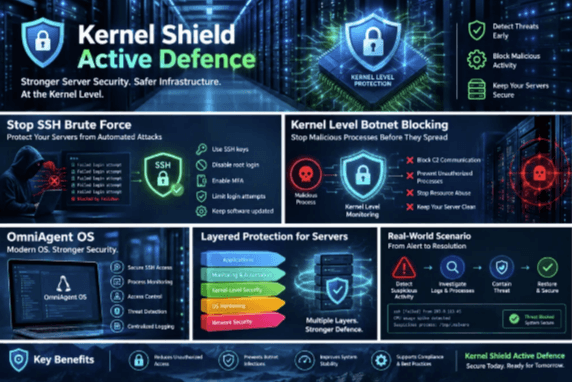
As cyberattacks against cloud infrastructure become increasingly automated, server security requires more than traditional firewalls and basic login protection. Attackers frequently target exposed services, exploit weak credentials, and deploy malicious processes that can turn compromised servers into botnet participants. For organizations managing Linux systems, hosting environments, and cloud applications, preventing these threats before they spread is an essential part of maintaining reliable infrastructure.
Kernel Shield Active Defence represents a security approach focused on strengthening protection closer to the operating system’s core. By combining operating system controls, behavioral monitoring, and automated threat response, organizations can improve their ability to detect suspicious activity and protect critical workloads. This approach is particularly relevant to SSH attacks, unauthorized processes, and other threats that can compromise server integrity.
Why Kernel-Level Defence Matters
The operating system kernel manages essential functions such as process execution, memory allocation, hardware access, and communication between software and system resources. Because so many operations depend on it, the kernel is an important layer for enforcing security policies and monitoring system behavior.
Traditional security tools remain valuable, but some threats can be difficult to detect through network monitoring alone. A malicious process may communicate over an allowed connection, consume resources gradually, or attempt to maintain access after an initial compromise.
Kernel-level security mechanisms can provide additional visibility into process activity and system operations. Depending on the technology used, they may help enforce restrictions, identify suspicious behavior, and prevent unauthorized actions.
However, kernel-level protection is not a replacement for a complete security strategy. Secure configurations, timely updates, application-level controls, and network defenses remain necessary. The strongest approach combines multiple protective layers rather than depending on a single technology.
Stop SSH Brute Force Attacks Before They Succeed
Secure Shell (SSH) is widely used to administer Linux servers and manage remote infrastructure. Its flexibility makes it essential for many technical teams, but publicly exposed SSH services are also common targets for automated password-guessing attacks.
In an SSH brute-force attack, automated tools repeatedly attempt to authenticate using different passwords or username combinations. If an attacker discovers weak credentials, the resulting access may enable data theft, malware installation, privilege escalation, or further attacks against connected systems.
Organizations looking to stop SSH brute force attacks should begin by reducing unnecessary exposure. Restricting SSH access to trusted networks or approved IP addresses can significantly reduce the number of systems able to reach the service.
Additional safeguards include:
- Use SSH keys: Prefer strong key-based authentication over passwords where practical.
- Disable direct root login: Require administrators to authenticate through controlled accounts and appropriate privilege escalation.
- Apply multi-factor authentication: Add another verification layer when supported by the environment.
- Limit access attempts: Use rate limiting or tools such as Fail2ban to respond to repeated authentication failures.
- Maintain current software: Install security updates for the operating system and SSH implementation.
- Monitor authentication logs: Investigate unusual login patterns, unfamiliar source addresses, and unexpected successful logins.
These measures make automated attacks harder to execute successfully. They also reduce the risk that a compromised account will become the starting point for a larger server incident.
Kernel Level Botnet Blocking and Malicious Process Detection
Botnets consist of compromised devices or servers controlled by an attacker. In cloud environments, infected systems may be used for distributed denial-of-service attacks, unauthorized cryptocurrency mining, credential attacks, or other malicious operations.
A compromised server can continue consuming computing resources long after its initial infection. Suspicious processes may restart automatically, create unauthorized network connections, or attempt to interfere with security tools.
Kernel level botnet blocking focuses on using operating system-level enforcement and monitoring capabilities to identify or restrict malicious behavior. Depending on the implementation, security mechanisms may monitor process execution, apply access policies, inspect selected network activity, or prevent prohibited operations.
For example, a server that unexpectedly launches an unfamiliar process and begins generating large volumes of outbound traffic may warrant immediate investigation. A properly configured detection system could flag the activity, alert administrators, or apply a predefined containment policy.
Linux technologies such as extended Berkeley Packet Filter (eBPF) can support certain forms of system observability and network monitoring. Other mechanisms, including Linux Security Modules and mandatory access controls, can help enforce restrictions on system behavior.
The capabilities and limitations vary by tool. Not every kernel-based security product can identify every botnet, and legitimate software can sometimes produce behavior that resembles malicious activity. Detection rules should therefore be tested carefully, with clear procedures for reviewing alerts and reversing incorrect actions.
OmniAgent OS and the Importance of Layered Protection
Modern server environments increasingly combine operating system security, workload monitoring, automation, and centralized administration. In this context, OmniAgent OS is a relevant keyword for discussions about operating system security and integrated defense workflows.
When evaluating any operating system or security platform, administrators should examine its documented capabilities rather than assume that its name guarantees a particular feature set. Important questions include whether the platform supports SSH hardening, process monitoring, access control, threat detection, centralized logging, and automated response.
Compatibility is equally important. Security mechanisms must work reliably with the organization’s kernel version, applications, container runtime, and deployment model. Poorly tested controls can interrupt legitimate workloads or create operational instability.
A layered deployment might combine secure SSH configuration, host-based monitoring, kernel-supported enforcement, network filtering, and centralized incident reporting. Each component serves a different purpose, reducing dependence on any single defense mechanism.
Organizations should verify product-specific claims against official documentation and independent testing before deploying a platform in production.
Automating Server Security Without Disrupting Operations
Automation can help security teams respond to threats more consistently. When a monitoring system identifies repeated login failures or suspicious process behavior, it can trigger an alert, apply a temporary network restriction, or isolate an affected workload according to approved policies.
Automated responses should be carefully designed. Blocking an address based on a single failed login could disrupt legitimate users, while terminating an unfamiliar process without investigation could interrupt a critical application.
A safer workflow uses graduated responses. Low-confidence events may generate alerts, while verified high-risk activity can trigger stronger containment measures. Administrators should maintain audit logs, test response rules, and establish recovery procedures for accidental disruptions.
Security automation should also integrate with existing operational processes. Centralized logs, incident tickets, and clear escalation paths help teams understand why an action occurred and what steps are required to resolve the issue.
This balance between rapid response and operational control is especially important for cloud platforms where downtime can affect customers, business applications, and service availability.
See also: Financial Planning for Business Growth
A Practical Server Security Scenario
Consider a hosting provider managing multiple Linux servers for business customers. Its monitoring systems begin recording repeated SSH authentication failures, followed by unusual CPU consumption on one machine.
Rather than simply increasing server capacity or blocking individual addresses indefinitely, the security team investigates authentication logs, running processes, and outbound network connections. The investigation identifies an unauthorized process that appears to have been installed following a successful login.
The team isolates the affected server, revokes compromised credentials, removes the malicious software, and checks for persistence mechanisms. It then strengthens SSH access controls and reviews other systems for similar indicators.
Kernel-supported monitoring and enforcement could provide additional visibility during this process, depending on the tools deployed. However, the investigation still requires evidence collection, careful analysis, and recovery planning.
This scenario demonstrates why effective server defense combines prevention, detection, containment, and remediation. No single control guarantees that a server will remain uncompromised.
Measuring the Effectiveness of Kernel-Level Security
Organizations should assess security improvements using measurable operational indicators. Useful metrics include the number of confirmed unauthorized access attempts, successful compromise incidents, time required to detect suspicious activity, and time needed to contain verified threats.
Administrators can also monitor false-positive rates, service availability, system overhead, and the compatibility of security controls with production workloads.
Regular testing helps identify weaknesses before attackers exploit them. Vulnerability assessments, configuration reviews, controlled security tests, and incident-response exercises can reveal gaps that ordinary monitoring may miss.
The goal is to improve protection without creating unnecessary complexity or degrading system performance.
Building a Stronger Foundation for Server Security
As automated threats continue to target internet-facing infrastructure, organizations need security strategies that address both network access and activity within the operating system. Kernel Shield Active Defence provides a useful framework for discussing layered protection, while SSH hardening, kernel-supported monitoring, and carefully managed automation can help reduce common server risks.
By combining practical controls to stop SSH brute force attacks with appropriate kernel-level botnet defenses, organizations can improve their visibility into suspicious activity and strengthen their response capabilities. Evaluating platforms such as OmniAgent OS requires the same disciplined approach: verify documented features, test compatibility, and measure real-world effectiveness.
Ultimately, resilient server security depends on multiple controls working together. Strong authentication, timely patching, reliable monitoring, and tested incident-response procedures remain the foundation of a secure and dependable infrastructure.