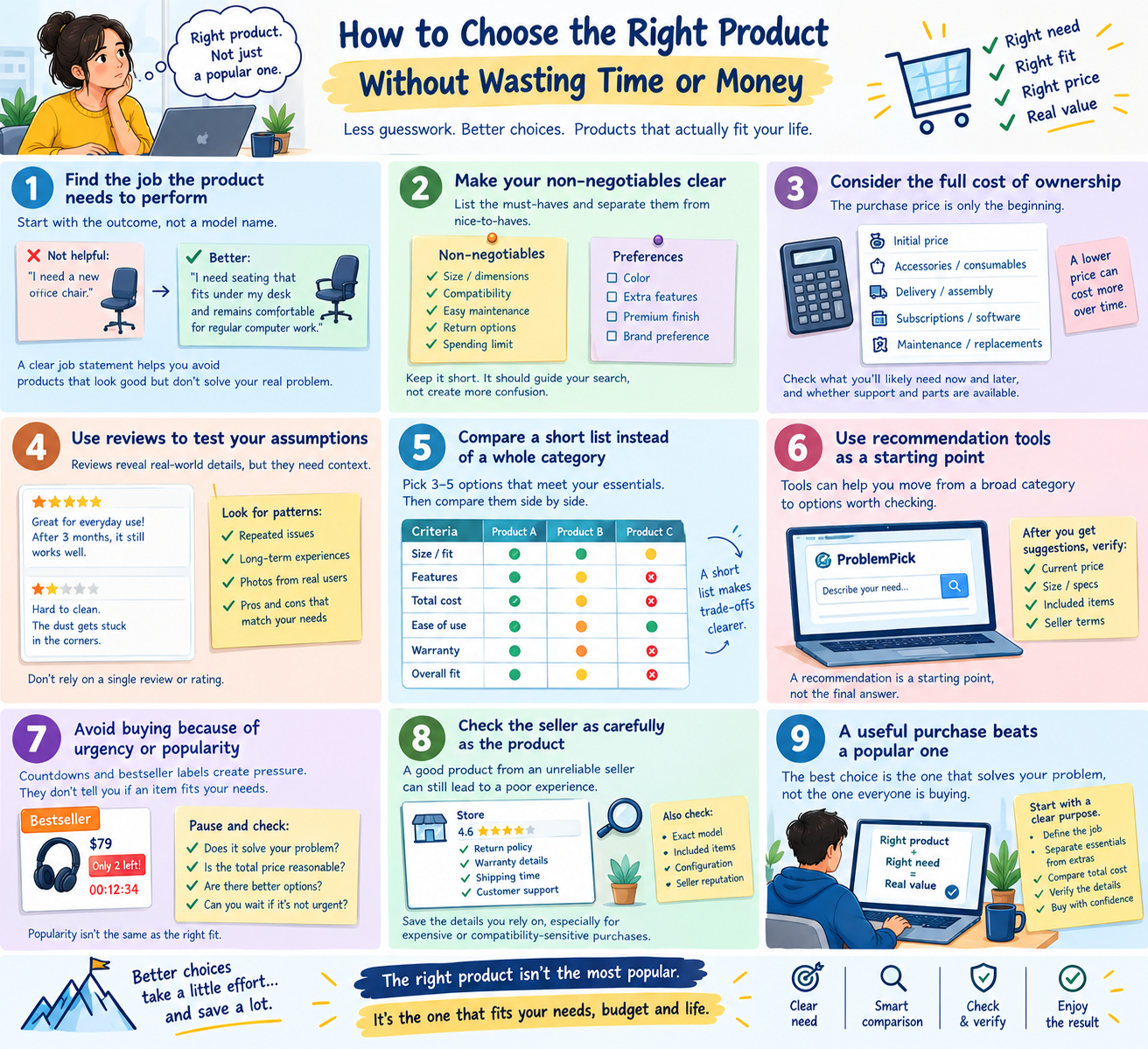
Online shopping offers more choice than most people can comfortably compare. Two items may promise the same result while differing in price, durability, setup, and ongoing expenses. Reviews can help, but they can also distract from the question that should guide the purchase: what do you actually need this product to do?
A reliable buying process does not require reading every product description. It requires identifying a few essential criteria, ruling out poor fits, and verifying the details before paying. Here is how to make that process more manageable.
Find the job the product needs to perform
Start with the outcome, not a model name. Instead of “I need a new office chair,” try “I need seating that fits under my desk and remains comfortable for regular computer work.” Instead of “I need a new travel bag,” write “I need an easy-to-carry bag for short trips that fits my usual belongings.”
This distinction matters because some products look attractive but solve the wrong problem. A large chair may have impressive features yet fail to fit your workspace. A lightweight bag may be convenient but lack the compartments you need.
If you cannot describe the intended job in a sentence, you may not be ready to compare products.
See also: Transform Your Appearance with Infinite Options through New Age Hair Technology
Make your non-negotiables clear
List the requirements a suitable item must meet. These can include size, compatibility, easy maintenance, return options, and spending limit. Keep the list short enough that it guides the search rather than becoming another source of confusion.
Then identify preferences. Perhaps you would like a particular color, extra setting, or premium finish. These can influence the final choice, but they should not outweigh the essentials.
This simple distinction prevents a marketing feature from crowding out what you actually need.
Consider the full cost of ownership
A price tag is only the beginning. A home device may need filters or accessories. Electronics may require cables, adapters, or subscription services. Furniture may involve delivery or assembly costs. An item with a lower sticker price can turn out to be more expensive over time.
Before choosing, estimate the costs you can reasonably anticipate and check whether replacements or support will be accessible when needed.
For example, if two printers seem comparable, research the type and cost of their consumables. If two desk lamps are similarly priced, check whether the light source is replaceable and whether the controls suit everyday use. These details often matter more than a small discount.
Use reviews to test your assumptions
Customer reviews can reveal aspects of a product that specifications leave out, but ratings need context. A five-star review after one day of ownership says something different from a detailed account after months of use. Both may be genuine; they simply answer different questions.
Read a sample of detailed positive and negative feedback. Look for patterns that relate to your priorities. If several buyers report awkward cleaning and easy maintenance is essential for you, that concern deserves attention. If a review complains about a feature you do not need, it may carry less weight.
Do not treat a single dramatic experience as proof that every unit will perform the same way. Look for repeated observations and check what the manufacturer and seller actually promise.
Compare a short list instead of a whole category
When you find three to five options that meet your essentials, stop adding products and start comparing. Create a simple grid with the criteria that matter most. Mark each item as strong, acceptable, or unsuitable on those criteria.
Imagine selecting a compact vacuum for small, occasional cleanups. You might compare storage footprint, cleaning access, accessories you truly need, ease of handling, and ongoing costs. The most expensive unit might rank first for features but not for fit or simplicity.
A shortlist exposes the trade-offs more clearly than a stack of browser tabs.
Use recommendation tools as a starting point
Discovery tools can help you move from a broad category to options worth investigating. A problem-first service such as ProblemPick focuses on starting with the need you are trying to address, which is a useful alternative to browsing products without a clear objective.
But no recommendation should bypass verification. Check current price, size, included components, availability, and seller terms on the relevant product listing. If a feature is essential, confirm it through an authoritative description rather than a summary alone.
Avoid buying because of urgency or popularity
Countdown messages, promotional language, and bestseller labels can create pressure. They do not tell you whether an item fits your use case. A widely purchased product may satisfy many people while being unsuitable for you.
If the purchase is not urgent, give yourself time to check the essentials. Compare actual total prices rather than relying on a claimed discount. If none of the available options meets the minimum requirements, the sensible decision may be to wait.
Check the seller as carefully as the product
A good product from an unreliable seller can still lead to a poor experience. Review return periods, warranty handling, shipping conditions, and support information. Make sure the exact configuration shown in the listing matches the version you want.
For expensive or compatibility-sensitive purchases, save the specifications you relied on when deciding. This makes it easier to ask questions or resolve problems later.
A useful purchase beats a popular one
A smarter purchase begins with a clear purpose. Define the job, separate essentials from extras, compare total cost, and use reviews to investigate real trade-offs. A product earns its place in your home or workspace because it solves a useful problem—not because a list, advertisement, or discount told you to buy it.