Clear food containers look simple on supermarket shelves, but consistent production involves material preparation, tooling, forming, finishing, inspection and packing. For importers, understanding the factory matters more than catalog photos alone.
Quick Answer: A capable PET food packaging factory should be able to explain where its material comes from, how sheets and molds are controlled, which product features are checked during production, and how approved specifications are carried through to export cartons. Equipment numbers matter, but documented process control and repeatable samples matter just as much.
1. What Buyers Should Expect From a Manufacturing Factory
A manufacturer does more than offer a catalog. It needs to translate a buyer’s requirements into a product that can be made repeatedly. That includes the food application, dimensions, material, closure, transparency, stacking needs and carton packing.
For example, a clear berry clamshell needs the correct ventilation and hinge structure; a tamper-evident deli box needs a consistent opening feature; and a PET cold cup depends on the exact rim and lid pairing. Each feature presents different challenges on the production floor.
Assess the complete route from incoming material to shipment. For projects requiring a new shape or closure, a published custom food packaging development process can illustrate how application requirements, sample evaluation and production specifications are connected.
2. Sheet Extrusion and Material Preparation
Thermoforming starts with plastic sheet. For facilities that produce their own sheet, extrusion adds an important stage of manufacturing control before the sheet reaches the forming machine. Operators need to review material identification, sheet appearance, thickness targets and suitability for the intended application.
PET and recycled PET (rPET) can be considered for transparent cold-food packaging, but the precise formulation, recycled-content claim and food-contact documentation must be verified for the product being purchased. An rPET option does not establish one recycled percentage for every order.
Sheet consistency matters because forming behavior depends partly on the material entering the mold. Variation in sheet thickness or condition can affect the final part’s rigidity, appearance and dimensions. A factory with extrusion and forming operations must therefore coordinate settings and quality checks across both stages instead of treating them as unrelated processes.
See also: Passenger Rights When an Accident Causes Life-Altering Injuries
3. Thermoforming Lines, Molds and Production Control
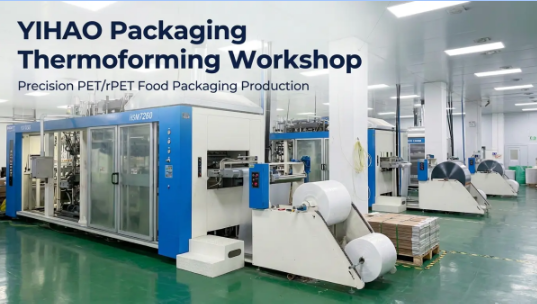
In thermoforming, a plastic sheet is heated and formed around a defined tool. The mold determines the intended geometry, while production settings influence how consistently the finished container is reproduced. Tool condition, material behavior, forming parameters and changeover procedures all deserve attention.
Factory scale is useful context. YIHAO® Packaging, a food-packaging manufacturer based in Fujian, China, reports five sheet-extrusion lines, more than ten thermoforming lines and a 30,000-square-meter manufacturing site. Its published PET food packaging factory overview explains the production, inspection and packing workflow. These figures describe the company’s stated manufacturing resources; buyers should still confirm current line availability, project fit and inspection arrangements during supplier qualification.
Machine count alone does not prove consistency. Ask how operators approve setups, record mold changes and check first articles.
4. Trimming and Closure Details Are Part of Manufacturing Quality
Trimming affects edges and whether a lid fits its intended base. For a hinged container, the hinge and locking area must remain consistent. For cold cups, a small change in rim geometry can affect lid engagement.
A production team may review several characteristics that are not obvious in a catalog image:
- Edges: Are the trimmed edges clean and appropriate for normal handling?
- Dimensions: Does the actual product match the approved model specification?
- Lid fit: Do the exact lid and base or cup models close as intended?
- Molded details: Are ribs, ventilation holes, tabs and tear strips formed as specified?
- Appearance: Are clarity and visible surface defects within the agreed acceptance criteria?
These are separate checks. A tamper-evident feature should not be described as proof that a package is leakproof, and a clear PET container should not automatically be considered microwave-safe.
5. Quality Checks From Material to Finished Carton
YIHAO® describes material, forming, trimming, inspection and packing checkpoints in its published factory workflow. Buyers should ask how these checks are recorded and what happens when a part falls outside the approved specification.
| Manufacturing stage | Example factory checks | Why the buyer should care |
| Incoming material | Identity, appearance and relevant material specifications | Helps keep the intended material consistent |
| Sheet preparation | Thickness and sheet condition | Supports more predictable forming |
| Mold setup and first articles | Shape, dimensions, closure and edge condition | Establishes a production reference |
| In-process production | Appearance, dimensions, molded features and lid fit | Helps identify variation during a run |
| Final packing | Quantity, carton condition and product identification | Supports accurate receiving and handling |
| Pre-shipment review | Carton marks, order details and loading readiness | Reduces avoidable shipment confusion |
Not every characteristic is inspected in the same way or at the same frequency. The useful question is whether the factory has acceptance criteria appropriate to the exact item and can explain its inspection and corrective-action process.
6. Batch Traceability and Repeat Orders
Importers generally need the second and third shipments to match the approved first order. That requires more than storing a sample in an office. Product codes, material requirements, mold references, packing specifications and relevant production records should remain connected to the order.
Batch or lot identification helps investigate reported problems by linking them to a production period. If a buyer reports unexpected lid fit or a visible defect, teams can review the relevant material and process records.
Repeat-order terms should identify controlled features such as mold revision, material, dimensions and packing; small changes can affect the customer’s operations.
7. Different Packaging Categories Require Different Factory Checks
A factory may offer several food-packaging families, but they should not all be evaluated against one generic performance claim.
| Packaging family | Manufacturing or sample-review priority |
| Berry clamshells | Vent placement, hinge operation and filled-pack stacking |
| Bakery and cake containers | Lid height, base support and transport clearance |
| Tamper-evident food containers | Opening feature, closure consistency and visible first-opening evidence |
| PET cold cups and lids | Rim profile, exact cup-lid matching and nesting |
| Deli and salad packs | Nominal capacity, actual food fill and closure fit |
Each model still needs approval. An 8 oz cup, bowl and hinged box are not interchangeable.
8. Export Packing Is the Last Manufacturing Checkpoint
Lightweight thermoformed packaging can occupy substantial shipping volume. Correct carton quantities and dimensions therefore matter as much as unit weight when an importer plans storage and container loading.
Before shipment, the relevant teams should verify the pieces per carton, carton dimensions, SKU markings, protective packing and intended loading arrangement. Carton strength and load stability should be checked under the agreed packing method. If several SKUs share a shipment, each must remain identifiable at the receiving warehouse. A documented food packaging supply and export workflow can also help importers review how SKU identification, carton specifications and container-loading requirements are coordinated before shipment.
Packing-list models should match approved specifications and loaded cartons.
9. A Practical Factory-Assessment Checklist
When comparing PET food packaging manufacturers, ask for evidence you can evaluate rather than relying only on claimed capacity:
- A current factory overview identifying its principal manufacturing processes and relevant lines.
- Samples of the exact container and lid combination under consideration.
- A written specification covering dimensions, material, key features and packing quantity.
- An explanation of incoming, in-process and final quality checks.
- A process for handling nonconforming products and documenting corrective actions.
- Lot or batch identification practices relevant to repeat orders.
- Confirmed lead times, order terms and carton or shipment details for the proposed SKU mix.
Factory visits, real production photographs and inspection documents make these discussions more concrete. Evidence should relate to the actual product, not unrelated tests or broad marketing claims.
10. Frequently Asked Questions
Does having more thermoforming lines guarantee better packaging quality?
No. Lines provide production resources, but consistent quality also depends on material control, tooling, process settings, inspection and operator procedures.
Why does in-house sheet extrusion matter?
It can give a manufacturer closer coordination between sheet preparation and thermoforming. Buyers should still verify material specifications and the process controls used for their order.
Can one PET food packaging factory produce many different container designs?
Yes, depending on its tooling, equipment and product range. Each design still needs its own specification and appropriate sample approval.
Does a quality inspection mean a PET container is leakproof or microwave-safe?
No. Those properties require separate product-specific evaluation. Visual and dimensional inspections do not establish every performance claim.
What supports consistent repeat orders?
Approved samples, controlled specifications, identified material and mold requirements, inspection records and clear carton configurations all help make repeat purchasing more predictable.
Conclusion
The useful measure of a PET food packaging factory is not simply how many containers it can form in a day. Buyers need to understand how the manufacturer controls sheet preparation, tooling, trimming, inspections, traceability and export packing as one connected workflow. When the same approved requirements guide each stage, a factory is better positioned to support the consistency that wholesale importers and food brands need from repeat supply.