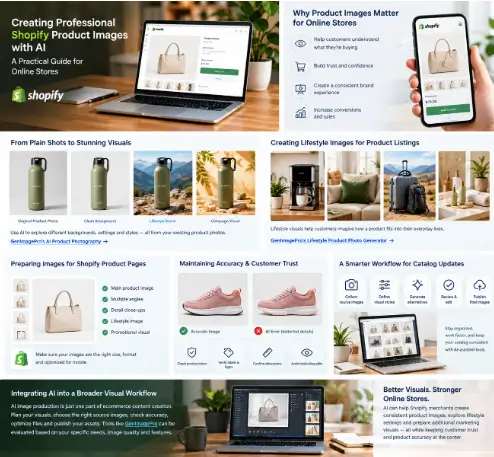
Why Product Images Matter for Online Stores
For online retailers, product images are a central part of the shopping experience. Customers rely on visuals to understand an item’s appearance, compare options, and decide whether it meets their needs. On platforms such as Shopify, consistent product imagery can also help a storefront feel more organized and professional.
Producing these images can be challenging as a business grows. New products require photographs, existing listings need updates, and seasonal promotions introduce additional creative work. Smaller teams may not have the budget or time to arrange a professional photoshoot for every change.
AI-assisted visual production offers another option. Using existing product photographs as a starting point, businesses can explore new backgrounds, lifestyle scenes, and creative presentations while maintaining a more consistent visual identity.
Understanding the Challenges of Ecommerce Photography
A growing online store may contain dozens or hundreds of products. Each listing may require a main image, supporting views, close-ups, and additional visuals that explain how the product is used.
When images come from different suppliers or photoshoots, their lighting, background colors, cropping, and overall quality may vary. These inconsistencies can make a product catalog appear less cohesive.
Traditional photography remains valuable when businesses need original images and precise control over the final result. However, repeating the entire production process for every variation can require substantial time and resources.
AI can help address some of these challenges by providing alternative ways to present existing product photographs.
Creating Clean and Consistent Product Images
Product images should make the item easy to recognize. Distracting backgrounds, inconsistent lighting, and uneven cropping can draw attention away from the product itself.
AI-assisted tools can help retailers explore cleaner backgrounds and coordinated visual styles. For example, a beauty retailer might choose neutral backgrounds for primary product images while using more expressive compositions for campaign content.
The GenImagePro AI Product Photography tool is one option businesses can consider when developing different product-photo styles from existing images.
To maintain consistency, teams should establish guidelines for background treatments, lighting, composition, and image dimensions. They should also review generated images carefully to ensure the product’s color, packaging, and shape have not changed.
Creating Lifestyle Images for Product Listings
A plain background provides clarity, but lifestyle photography adds context. It can help customers imagine how an item might fit into their daily lives.
A coffee maker might be shown on a kitchen counter, a cushion in a furnished living room, or a travel accessory in a carefully arranged luggage scene. These images can support product pages, promotional banners, and social media campaigns.
AI-assisted lifestyle production allows teams to explore different environments without physically arranging every setting. A retailer can compare several visual directions and select those that best suit its audience and brand identity.
The GenImagePro Lifestyle Product Photo Generator is relevant to this approach because it focuses on lifestyle-oriented product visuals. Such workflows can help businesses develop additional creative options from existing product photographs.
However, lifestyle images must remain believable. The setting should not suggest that a product includes accessories, features, or materials that are not actually part of the item.
Preparing Images for Shopify Product Pages
Different images serve different purposes within an online store. The primary product image should clearly show the item, while secondary images can communicate details, alternative views, or usage scenarios.
A product page might include:
- A clear primary image showing the actual product.
- Additional views highlighting important features.
- A lifestyle image providing context.
- A promotional visual for a relevant campaign.
Before publishing, retailers should check image dimensions, file size, file format, and appearance on mobile devices. Large files can affect loading performance, while inconsistent crops may make product grids look untidy.
AI-generated visuals should fit into this publishing process rather than replace it.
Maintaining Accuracy and Customer Trust
One of the main challenges of AI-assisted ecommerce photography is preserving the product’s real appearance.
An AI-generated image might alter a handbag’s stitching, distort a cosmetic label, change a fabric’s texture, or make a furniture item appear to have different proportions. Even small discrepancies can confuse customers.
Businesses should compare final images with the actual products before publication. Colors, logos, dimensions, packaging, and distinctive design features deserve particular attention.
For products where exact appearance matters, verified original photographs should remain the primary reference. Creative lifestyle images can complement factual product photography, but they should not misrepresent what a customer will receive.
Managing Catalog Updates More Efficiently
Online catalogs change frequently as retailers introduce new products, update colors, and prepare seasonal campaigns. AI-assisted production can help teams explore new visual presentations without rebuilding every scene from scratch.
A repeatable process can make this work easier to manage. Teams can organize source photographs, define approved styles, generate alternatives, review outputs, and store the final images with clear filenames.
This approach can also improve collaboration between designers, marketers, and ecommerce managers. Everyone can work from shared visual guidelines rather than creating unrelated styles for individual listings.
Integrating AI into a Broader Visual Workflow
AI image production is only one stage of ecommerce content creation. Businesses still need to plan their visuals, select suitable source images, check accuracy, optimize files, and publish approved assets.
Platforms such as GenImagePro can be evaluated as part of this workflow according to image quality, available features, usage terms, and business requirements.
The aim is not to generate as many images as possible. It is to produce useful, accurate visuals that support the customer experience and the brand’s commercial goals.
Conclusion
AI can help Shopify merchants create consistent product images, explore lifestyle settings, and prepare additional marketing visuals. These capabilities may be particularly useful for businesses managing large catalogs or working with limited creative resources.
The best results come from combining AI-assisted production with clear visual guidelines and careful quality control. When product accuracy and customer trust remain priorities, AI can become a practical addition to a modern ecommerce workflow.